
Saying no to the Swansea Bay tidal lagoon was not a failure of ambition
David TC Davies
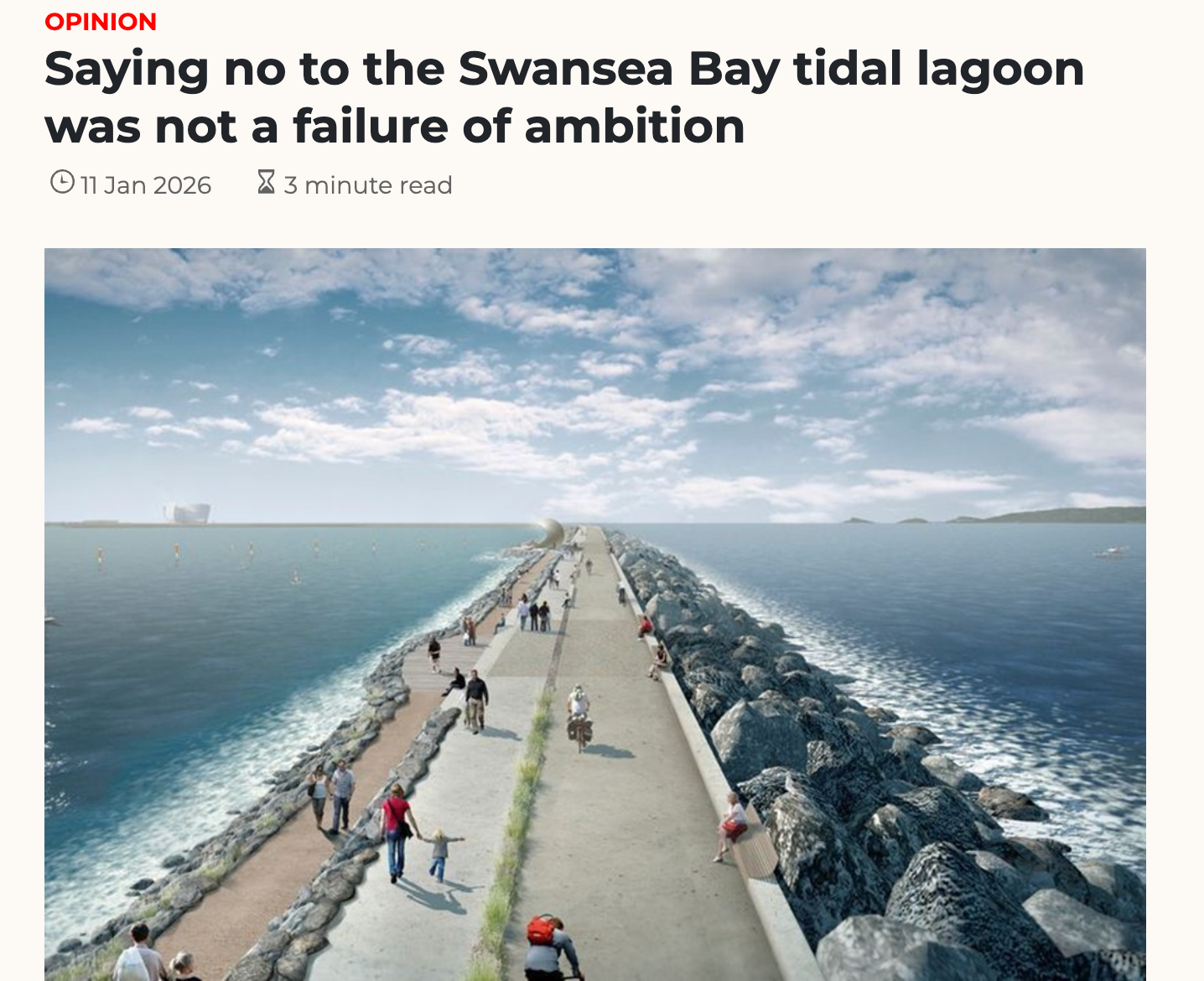
In Nation.Cymru today I responded to a criticism about the decision to turn down the Swansea Bay Tidal Lagoon Scheme.
Too many politicians in Wales are carried away by a well-produced video, a glossy brochure and an appealing vision of what might be. Serious government requires something more hard-headed: clear figures, and a proper understanding of who ultimately carries the risk and the cost.
Although I am not normally a fan of Rachel Reeves, in 2018 we jointly chaired a cross-committee inquiry into the Swansea Bay Tidal Lagoon proposal, which Cll Sam Bennett wrote in support of for Nation.Cymru earlier this week. Despite our very different political views, the current Chancellor and I reached the same conclusion: we were not satisfied by the evidence put forward by the developers.
The most obvious problem was cost. The developers accepted that, to be viable, the lagoon would have required a Contract for Difference strike price of around £150 per megawatt hour in 2012 prices. By comparison, Hinkley Point C was agreed at £92.50 per megawatt hour, also in 2012 prices, for a 35-year contract. Claims that the lagoon could deliver electricity at the same price as nuclear were utter rubbish.
The cost of the CfD would have been paid for by energy bill-payers at a time when energy bills were already far too high.
There were also serious risks. This was a first-of-a-kind project in a demanding marine environment. If construction costs rose — as they so often do on complex infrastructure projects — the taxpayer would almost certainly have been left carrying the can.
A tidal lagoon cannot simply be abandoned halfway through; an unfinished structure in the Severn Estuary would have created environmental and navigational problems, leaving government ie the taxpayer to step in regardless of cost.
Environmental and governance concerns also remained unresolved. The project required millions of tonnes of rock for its seawall, raising legitimate questions about quarrying, supply chains and conflicts of interest that were still not fully addressed when Parliament was being asked to commit billions of pounds of public money.
The reason the lagoon did not go ahead was not a lack of vision or hostility to renewable energy. It was because, when politicians across parties quietly examined the figures instead of the glossy brochures, serious doubts emerged. That included Labour politicians, including some prominent figures within Swansea Council.
Wales needs investment and growth, but it also needs politicians prepared to stand up for taxpayers. Saying no to the Swansea Bay tidal lagoon was not a failure of ambition; it was a rare instance of politicians doing what they are elected to do — properly scrutinising a proposal that needed billions of pounds of public money, and refusing to load higher energy costs onto bill-payers on the basis of an unproven scheme.